Chapter 2The agent: Formal definition and properties
This chapter fixes the term agent for the remainder of the book. The book’s actual subject is the agentic system, defined in Chapter 1 as a system that embeds probabilistic reasoning components inside deterministic infrastructure, and the thesis that reliability lives in that deterministic shell, not in the model, is what the rest of the book develops. The agent is the component whose definition this chapter fixes, for one reason: a reader needs to know whether the system in front of them is the kind of system this book’s patterns address. The four properties below are the discriminator that answers that question. They are deliberately strict so that architectural decisions can be reasoned about without ambiguity, and so that applying the book’s discipline to a system that is not an agent adds ceremony without benefit.
The definition is intentionally structural. It is not tied to any particular model, framework, or prompting strategy, and it is not a claim about general intelligence. The book’s concern is bounded autonomy: explicitly constrained reasoning and action loops with cost, iteration, and risk limits enforced by architecture (Chapter 5).
Formal definition
An agent, as defined in this book, is:
Definition: Agent A stateful, goal-directed computational entity that reasons about possible actions, selects among them, executes actions in an environment, and updates internal state based on feedback.
The definition is intentionally compact. It excludes systems that merely compute outputs from inputs, systems that can only talk but cannot act, and systems that can act but do not close the loop by incorporating feedback into subsequent decisions. It is structural, not behavioral: it says nothing about whether the agent uses a large language model, a symbolic reasoner, a rule engine, or some combination, and nothing about the model’s size or capability. What it asserts is the shape of the component, a closed loop with state, goal-directed choice, action, and adaptation. Any system with this shape is an agent under this book’s terminology; any system without all four properties is not.
The agent boundary
An agent is a logical boundary around a closed loop of state, goal-directed choice, action, and feedback. A useful architectural test is whether you can draw an “agent box” and identify what crosses its boundary.
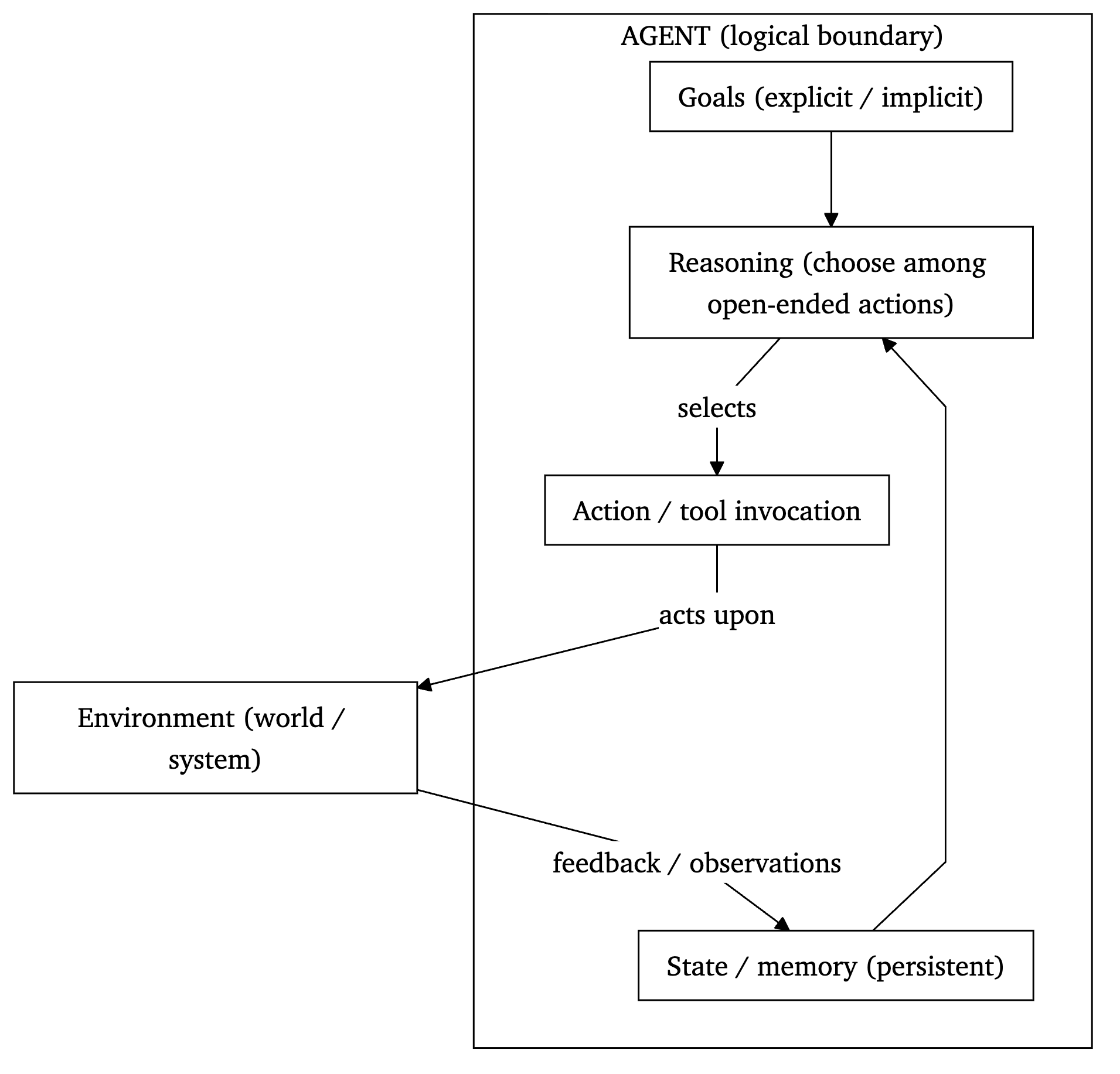
Several later patterns (Control, Governance, Memory) can be understood as externalizing parts of this box into deterministic infrastructure while leaving the agent with bounded decision-making. Once the agent is a closed loop of state, choice, action, and feedback, the rest of the book is about which parts of that loop the architecture pulls out and enforces deterministically, so that the probabilistic component is left to reason inside limits it cannot widen. The agent boundary is a logical line around the closed loop of choice and feedback; it need not coincide with a process boundary. Production reliability depends chiefly on the deterministic controls outside that logical line.
Four distinguishing properties
The definition operationalizes as four properties. Remove any one of them and the system ceases to be an agent under this book’s terminology.
1. Statefulness across steps
Statefulness means the agent carries information across reasoning-action iterations in a way that affects future choices. The state can be small (a handful of variables) or large (structured memory), but it must persist beyond a single function call, so the agent cannot be evaluated only as a pure mapping from input to output.
Architecturally, the system must decide where state lives (in-process, an external store, or a dedicated memory subsystem; see Chapter 7), how it is updated (append-only logs, snapshots, derived summaries), and how it is validated and governed (Chapter 6). Two confusions are worth disposing of quickly. Having access to history is not the same as being stateful, since a stateless service can read a log and still behave as a pure function of the current request. Caching is not state, because it improves performance without representing commitments, hypotheses, or evolving beliefs. The practical test is whether a fact the agent established earlier can change what it does later. If the component’s behavior depends only on the current input and freshly queried data, it may be automated, but it is not operating as an agent. Whether that state also survives a process restart is a separate, production-strength requirement, taken up in Chapter 7.
2. Explicit or implicit goals
Goal-directedness means the agent’s behavior is evaluated against a notion of success that is not fully captured by the immediate input. The goal may be explicit (a declared objective and constraints) or implicit (policy-derived, role-derived, or inferred from a task description), but it must exist as something the agent can use to select among alternatives.
The selection is among open-ended alternatives, actions and sequences not reducible a fixed, enumerable set of branches known at design time. This is the line between a goal-directed agent and a deterministic controller. A thermostat selects between on and off against a target temperature and adapts to feedback, yet no one would call it an agent: its choice set is fixed and its transitions are enumerable. When every action a system might take is known and encoded in advance, it is a workflow, however much state and feedback it carries (see the boundary cases below). The agent property requires that the space of choices be open.
Goals are architectural objects because they determine termination criteria (what counts as “done”), tradeoff policy (latency versus correctness, cost versus thoroughness), and acceptable risk (what can be attempted autonomously). The definition requires a goal but does not require termination. An agent that loops indefinitely toward an unsatisfiable goal satisfies all four properties; nothing in the definition stops it. That gap is what bounded autonomy (Chapter 5) and the governance layer (Chapter 6) close from outside, by enforcing iteration, cost, and time limits the agent cannot widen. Termination is a responsibility of the system around the agent, not a property of the agent itself.
Goals also delimit responsibility, and here an architectural consequence follows. A goal carried only as a role, “you are a helpful coding assistant,” is convenient in a demo and nearly impossible to govern, because a deterministic policy gate cannot evaluate whether an implied objective was satisfied, only whether an explicit one was. Promoting the goal to an explicit, measurable objective, stated with success criteria and constraints, is the first step in turning an agent from a plausible demo into a governable component. The definition admits implicit goals; the architecture discourages them. In later chapters, goals interact strongly with bounded autonomy (Chapter 5): if you cannot state constraints (budget, allowed actions, unacceptable outcomes), you cannot bound autonomy in a meaningful way.
3. Capability to act upon an environment
An agent must be able to cause effects outside itself, invoking tools, mutating state in external systems, initiating workflows, making commitments, or otherwise changing the environment. This property is the transition from analysis to operations. The moment an agent can act, side effects must be made observable and attributable, actions must be validated (schema, policy, authorization), and high-risk actions must route to escalation (Chapter 6).
Environments can be physical (robots), digital (APIs, databases), or social (ticketing systems, communications); the book treats the environment abstractly, as the substrate in which actions have consequences and from which feedback is observed. A system that generates text but cannot trigger actions is best treated as a decision-support component rather than an agent. It can still be useful, but many of the failure modes of agentic systems (cascading side effects, irreversible actions) do not apply.
4. Adaptation based on outcomes
Adaptation means the agent incorporates feedback from the environment into subsequent reasoning and behavior. Feedback can be immediate (a tool result, an error code) or delayed (an evaluation outcome, a user correction), but it must change the agent’s future action selection. Adaptation is not necessarily learning in the ML sense; the book does not require gradient updates or fine-tuning, and it can be as simple as revising a plan after a tool call fails or recording a constraint and proceeding differently.
The architectural distinction is between two time horizons. Intra-task adaptation happens within a single run; inter-task adaptation happens across runs, when the agent updates a persistent store so a mistake made today is not repeated in next week’s session. Both satisfy this property, but they rest on different memory architectures (working memory for intra-task adaptation, episodic or semantic memory for inter-task; Chapter 7), and they carry different governance risk, because inter-task adaptation lets one session’s outcome change another session’s behavior. Adaptation also introduces the problems that motivate much of the rest of the book: feedback can be noisy, adversarial, or incomplete; the loop can oscillate without convergence; and the agent may overfit to short-term signals. Cognitive structures that improve reasoning under uncertainty (Chapter 4), governance constraints that prevent runaway adaptation (Chapter 6), and evaluation that detects drift across runs (Chapter 12) are the responses.
What is not an agent (boundary cases)
The value of the definition is what it excludes: systems that look agentic but lack one of the four properties. Most boundary cases reduce to a single missing property and need only be named.
A stateless service that computes a response from a request (no state, no goal-directed choice) is infrastructure, often the deterministic shell an agent runs inside. A scripted workflow or RPA process (state and action, but a fixed, enumerable choice set rather than open-ended selection) is a workflow, and the book recommends it over an agent wherever the domain is stable. Anthropic’s workflows sit on this side of the line: their reliability comes from the path being predetermined in code, which is exactly the absence of the open-ended-choice property. A planner that never executes (no action, no feedback) is a planning subsystem.
Two further cases look agentic mainly in presentation. A reactive tool router that maps inputs to tool calls with no goal-directed reasoning and no cross-step state is a router. Several “agents” packed into one prompt are one agent stylized as several unless each maintains independent state, goals, and adaptation. These are category statements, not value judgments: a workflow or a router is often the better tool. The patterns in this book address systems that have all four properties, and applying them elsewhere adds ceremony without benefit.
The most common boundary confusion is the chat interface. A chat surface that generates text but cannot execute actions, or whose actions are always carried out by a separate deterministic process the model never selects, serves decision support under this definition. A chat interface can host an agent when the loop behind it includes tool invocation, feedback incorporation, and persistent state that influences subsequent steps. The interface is then a presentation layer over an agent. Before applying agentic patterns to a chat product, ask whether the system behind the chat box closes a loop that the architecture must bound.
Agents, tools, and deterministic infrastructure
The common architectural mistake is to treat the agent as the whole system. In production, the agent is almost always a bounded component inside the deterministic shell: the tool adapters, schemas, policy gates, human oversight, memory stores, and trace that Chapter 1 named and that the rest of the book develops. The agent is the decision-maker inside a loop, and the surrounding infrastructure defines the permitted action surface. The full design of that loop, the envelope around the model, is the harness, introduced in Chapter 4 and designed in Chapter 19; this chapter’s job is only to fix what sits inside it.
The Skills layer (Chapter 10) extends this decomposition with a runtime mechanism for loading capability descriptions on demand. Skills do not change the agent boundary; they change what the agent can be asked to do without re-deploying the system. The architectural implication of Skills is treated in Chapter 10.
Bounded autonomy as a property of agents-in-systems
Production reliability requires externally enforced limits on reasoning loops and action surfaces. The agent that satisfies all four properties is, by that fact, a component capable of doing real damage: it iterates, it spends, it acts on the world, and it carries state forward that can be wrong. Those four capacities are exactly what the definition admits, and they are exactly why the definition is strict enough to be worth bounding.
Bounding autonomy means imposing explicit limits on iterations, cost, time, action surface, data access, and reversibility. Some of these bounds can be internal to the agent (stop conditions); most must be enforced externally by the governance layer (Chapter 6), because an agent cannot be relied upon to police itself under uncertainty or adversarial conditions. Chapter 5 develops bounded autonomy as a discipline in its own right; the point here is only that the definition makes bounding necessary rather than optional, by admitting only systems capable of the loop-shaped damage the bounds exist to contain.
Summary
An agent, in this book, is defined by a closed loop: persistent state, goal-directed choice among actions, the capability to act on an environment, and adaptation based on feedback. The definition is deliberately strict so that architectural decisions can be reasoned about without ambiguity.
With the term fixed, Chapter 3 introduces the architectural forces that agentic patterns must balance, and the remainder of the book presents the patterns and the discipline that turns those balances into reliable systems.