Chapter 13The glass layer: UI and interaction architecture
In a conventional web application the user interface is a presentation layer. If the backend enforces its invariants, the system is correct no matter how the frontend renders the data; the UI can be redesigned without touching the security model. Agentic systems break this separation. Chapters 5 and 6 established that much of an agentic system’s reliability rests on the reversibility envelope and on human-in-the-loop (HITL) approval gates. The moment a human sits inside the control loop, the surface that human reads and acts through becomes part of the enforcement mechanism, and an approval gate only enforces anything if the reviewer actually reads what they approve.
This chapter treats the glass layer, the user interface and client-side interaction state, as architectural structure when user interaction bears enforcement duties. The name is meant literally: the glass is the pane the user reads the agent through and acts on it through, and the layer’s job is to keep that pane transparent, with reasoning visible and risk legible, while it bears structural load. When the UI hides the agent’s reasoning, buries the risk, or makes approval a reflex, the governance layer has not failed in the backend; it has failed at the glass. The governing commitment of the chapter: if the human is the final policy gate, the UI is the policy engine.
The streaming-versus-validation paradox
The first architectural conflict in agentic UI sits between user experience and governance, and it has no purely cosmetic resolution.
Users expect a model to stream its output token by token; a time to first token (TTFT) much above two seconds reads as broken. Chapter 6 requires that output pass through schema validators and policy gates, data-loss prevention, toxicity checks, grounding checks, before it reaches the user. These requirements collide. A regular-expression scrubber, a schema validator, and a model-based policy judge all need a complete unit of output to evaluate. Buffer the whole response to validate it and streaming dies, turning a one-second first token into a fifteen-second wait. Stream straight to the user to preserve the experience and a policy-violating span renders on screen before any gate has seen it.
The glass layer resolves the conflict in one of two ways, and the choice is an explicit architectural decision with a regulatory dimension. The two options trade latency against exposure risk, and the right choice turns on whether a brief flash of policy-violating content is itself the harm.
| Option | Time to first token | Exposure risk | When to use |
|---|---|---|---|
| Chunked buffering | Modest increase (a gate runs per semantic unit) | None; no unvalidated text is ever rendered | Regulated settings where a momentary flash of protected data is a reportable disclosure; the correct default there |
| Optimistic streaming with rollback | Ideal (tokens stream immediately as provisional output) | Brief; a violating span is visible before retraction | Low-stakes, high-interactivity surfaces; wrong wherever a brief exposure is the harm |
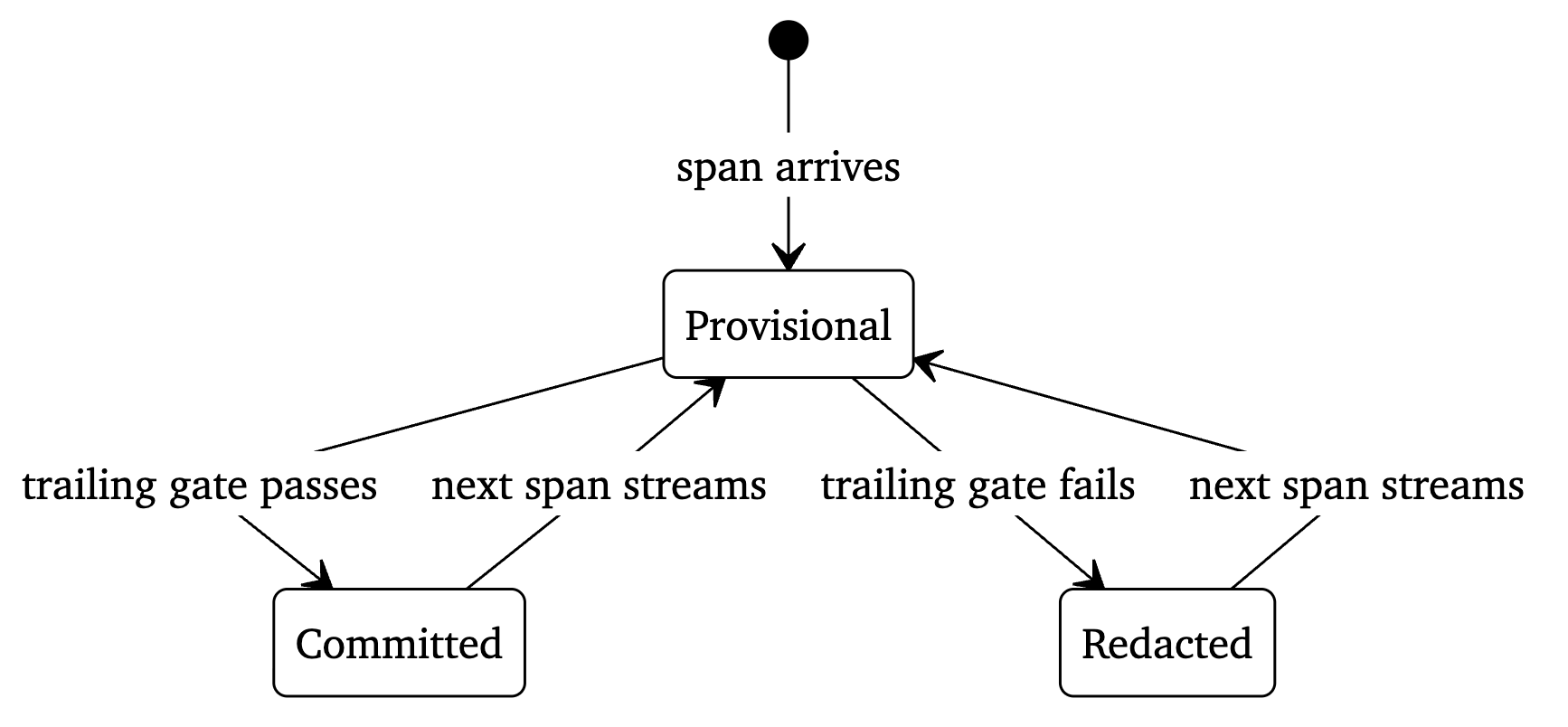
In chunked buffering, the backend accumulates output into semantic units, a complete sentence or a complete structured field, and runs the policy gate on each unit; a unit that passes is flushed over server-sent events or a socket, and a unit that fails never leaves the server. In optimistic streaming, the client holds an explicit state machine over the rendered text: provisional text is rendered in a visibly distinct treatment, commits to its normal appearance when the trailing gate clears, and is replaced by a redaction block with a short explanation when the gate fails. The state machine is the cost the option buys its latency with.
Optimistic streaming state machine
Each streamed span cycles through provisional, committed, and redacted render states; only a passing trailing gate commits text to its final appearance.
This gate is distinct from the model gateway’s egress filter (Chapter 15): it enforces Chapter 6 on generated output at the moment of display, on its way to the user, not on prompts on their way to the provider. Chapter 15 develops the distinction in full.
Trace progressive disclosure
Chapter 12 established the structured trace as the system of record for model steps, bound checks, policy decisions, and tool calls. The glass layer must decide how much of that record to show. A chat box that hides the trace behind a thirty-second spinner leaves users with little basis for trust.
Dumping raw debug events creates a different problem: reviewers stop reading under the volume. Progressive disclosure maps granular backend events to a small set of human-legible milestones while keeping the detail available on demand.
| Backend trace event | Client rendering |
|---|---|
| Session start | Initialization state |
| Agent thought | Hidden behind an expandable reasoning toggle |
| Skill activated | “Loaded project guidelines” (shows the context is grounded) |
| Action proposed | “Preparing to search the codebase…" |
| Tool call, slow | “Searching 450 files…" (surfaces action latency) |
| Policy gate, deny | “Action blocked by policy: diff contains secrets” |
| Approval requested | Halts the stream; renders the approval component |
The client subscribes to the event stream and folds it into a single task-state object that drives the rendering. Surfacing tool calls and passing gates changes the user’s mental model from chatting with an oracle to supervising a junior colleague, and a supervisor reads before approving. The mapping is deterministic: the UI state derives from typed trace events, never from text the model emitted about its own progress.
Approval queues and structured friction
When a risk score crosses a threshold or an action breaches the reversibility envelope (Chapter 5), the backend suspends the agent and requests human approval. A dialog reading “The agent wants to run a database migration. Cancel / Approve” gives the reviewer too little context to assess the action. Reviewers under time pressure may approve simply to unblock the task.
The approval surface must impose structured friction that requires the reviewer to examine the action and its consequences before execution.
An approval component carries five commitments.
-
Project the reversibility envelope. State the stakes in plain terms: whether the action mutates production data and whether it can be rolled back automatically.
-
Render the payload, not the prompt. Show the exact deterministic artifact that will execute, a code diff, the literal tool arguments, never the agent’s prose summary of its intent. A reviewer approving a summary is approving a paraphrase.
-
Surface the risk score and its triggers. Display the backend’s risk score and name the policies that fired (“risk 45 of 50; trigger: diff exceeds 500 lines”), so the reviewer knows why the action was held.
-
Allow the payload to be edited. When the agent proposes a large change with one mistake, forcing a full reject-and-reprompt cycle is the friction that trains reviewers to approve blindly instead. Let the human edit the tool arguments in place and approve the corrected version; the reviewer becomes a participant in the control loop rather than a gate on it.
-
Require explicit acknowledgment for the highest risk. For irreversible actions, keep approval disabled until the reviewer checks boxes corresponding to the specific risks (“I have verified this query contains no personal data”). The added friction is deliberate.
Steering and interruption
Approval is the human acting on an action the agent has proposed. The harder case is the human acting on an agent that is already running, watching the trace unfold and judging, before any gate fires, that the agent has misunderstood the goal. The glass layer is the surface for that intervention, and it supports two forms of it: stopping the agent and steering it.
Stopping is the emergency case. A user who sees the agent confidently editing the wrong module wants it to halt now, before it spends another dollar or touches another file. Closing the browser tab does not achieve this. The backend loop keeps reasoning, spending, and acting after the observer is gone (Chapter 9). The glass layer must therefore expose an explicit stop control, present throughout a run rather than buried in a menu, wired to the deterministic interrupt signal that terminates the loop, severs the open model connection, and cancels in-flight tools. The interface commitment mirrors the one for approval: the stop is confirmed by a typed session. trace event rendered as a terminal state, not by an optimistic spinner, and any partially completed action sequence shows its compensating rollback, so the user can see the system was left consistent rather than abandoned mid-mutation.
Steering is the softer and more common intervention. Often the supervisor does not want to abort but to correct: you are editing the staging config, not production; skip the integration tests, they are known to be flaky today. The naive implementation injects the correction as another conversational turn and leaves the model to attend to it. The architectural implementation treats steering as a deterministic control event. It captures the correction as a typed message, injects it into the agent’s working memory as a high-priority observation at the next loop boundary (Chapter 7), and records it in the trace. The trace then shows whether the agent incorporated the correction and lets reviewers audit the intervention. Steering redirects the agent within its existing limits; it cannot widen them. A mid-run correction is still subject to the bounding layer (Chapter 5), so a human cannot use the steering channel to push the agent past a cost ceiling or onto a tool outside its action surface; the same discipline that prevents the agent from expanding its own authority prevents a hurried operator from doing it on the agent’s behalf.
The unifying principle is the one that governs the rest of the glass layer: real-time human input is a stream of typed control events with defined semantics and trace records, never free text the model is trusted to interpret correctly.
Trust calibration and seams
A conventional interface is designed to feel fast and authoritative. An agentic interface carries a competing obligation, because an interface that looks too polished invites the user to over-trust the probabilistic system underneath it. Where a claim or an action is uncertain, the interface makes the uncertainty visible as state: the source behind a claim, the tool activity behind a delay, the approval still pending, the provisional status of streamed text. The glass layer’s job is to keep the user’s trust calibrated to the agent’s actual reliability.
Three mechanisms do most of this work. Grounding ties rendered claims to their sources. For task classes where the user acts on the answer, each factual claim carries a clickable citation derived from recorded provenance. The citation may point to a semantic-memory chunk (Chapter 8), a tool observation, or a live query result. The UI marks an unsupported sentence as unverified synthesis.
When a cognitive pattern (Chapter 4) explores several branches, the UI can show the runner-up and why it lost. This helps the user assess the chosen path. Deterministic interaction tools handle requests for input. The agent invokes a typed request-for-input tool, and the UI renders its event as a structured form without depending on model-generated phrasing.
Asynchronous hydration
Enterprise agentic workflows can run for hours, waiting on rate limits, slow external tools, or a human in an approval queue, so the glass layer cannot assume a browser tab stays open on a live socket for the duration. The client must treat a session as an asynchronous, durable task rather than a connection.
The architecture follows from that premise. The client subscribes to a session identifier rather than holding a connection. When the user closes the laptop and the agent is waiting on an external system, the backend hydrates the agent’s state to durable storage and sleeps it (Chapter 5). When the user returns, minutes or days later, the client fetches the trace from the trace store, replays the event log through the same client-side state machine that drives live rendering, and reconstructs the progressive-disclosure view exactly where it left off. The presentation layer is ephemeral; the reasoning loop and its trace are durable; replay is what connects them.
Testing the glass layer
The discipline that makes the glass layer structural also makes it testable. Because interaction state derives from typed trace events rather than from the model’s text, the client is a deterministic function of an event log, and an event log is a fixture. A recorded trace can be replayed through the client state machine to assert that the rendered milestones match the events, that a failing trailing gate drives a provisional span to its redacted state, and that the approval action stays disabled until the required acknowledgments are checked. None of these tests invoke a model; they are ordinary assertions over a state machine (Chapter 12). A UI whose state was parsed from model output could not be tested this way, which is a second reason, beyond correctness, to drive it from the trace.
Anti-patterns at the glass
The magic chat box. A surface consisting of a text input and a streaming output, hiding every tool call, retrieval, and gate. It produces frustration when a response takes forty-five seconds with no visible progress, and blind trust in whatever finally appears.
The looks-good-to-me button. An approval flow that defaults to approve, takes one click, and never shows the execution payload. It nullifies the backend reversibility envelope by moving the decision to a reviewer who has seen nothing to decide on.
Prompt-rendered UI state. Instructing the model to emit its own interface state, “begin your reply with a waiting marker if you need input.” The model will eventually hallucinate the marker, or omit it. UI state must be driven by deterministic backend trace events, never parsed from the model’s text.
Summary
The glass layer is where the system’s governance and bounded autonomy reach the user, and its interaction state is deterministic: derived from typed trace events and control events, never parsed from model text. It resolves the streaming-versus-validation paradox through chunked buffering or optimistic rollback; it translates raw traces into progressive disclosure so the user supervises rather than chats; and it imposes structured friction on approvals so a human gate stays a real gate. That discipline is what keeps the human a reliable, structural component of the system’s safety posture. Chapter 14 turns outward, to the problem of embedding these systems inside the legacy, multi-tenant enterprise platforms where most of them will actually live.