Chapter 18Operationalization and production
Part IV opened with whole-system vignettes (Chapter 16) and a worked example (Chapter 17). This chapter pulls operational discipline together (deployment, cost, scaling, observability, lifecycle) before the harness capstone.
The architecture described in Chapters 5 to 10 and composed in those synthesis chapters has to run. This chapter is the operational counterpart: the disciplines that turn the architecture into a system that holds up under production load.
Operationalizing an agentic system is closer to operating a complex distributed system with a third-party dependency (the model) than to running a traditional application. The dependency has its own release cadence, its own cost dynamics, and its own failure modes. The team has to be ready for all of them.
This chapter is organized around five operational disciplines: deployment, cost economics, scaling, observability, and lifecycle. Each has been touched on in earlier chapters; here they are pulled together into the operational discipline that the system needs from day one.
Deployment
Agentic systems are not deployed differently from other software in their deterministic substrate. The deployment of the bounding layer, governance layer, memory gateway, and orchestration code follows standard practice: version-controlled artifacts, reproducible builds, staged rollout, canary deployments, rollback paths. The network topology around the model, where inference runs and what data may cross which boundary, is itself a deployment concern, enforced by the model gateway and its egress rules (Chapter 15).
What is new is that the system has a probabilistic component whose behavior can shift between deployments without code changes. The model provider releases an update; the policy gates that worked yesterday catch different content tomorrow; the cost per response shifts; the latency distribution moves. The deployment discipline has to admit this.
The operational pattern is to treat the model as a deployable artifact in its own right:
-
Pin model versions in production. Do not depend on a moving alias like “the latest.” Pin a specific, immutable version identifier for production traffic, the way you pin any other dependency.
-
Test new model versions in a canary track. Replay production traces against the new version; assert envelope properties (Chapter 12). Promote only when the envelope holds.
-
Roll back the model the same way you roll back code, when you can. A model upgrade that produces incidents should be reversible to the prior pinned version without code changes.
-
Plan for provider deprecation with portability and fallback routing. Managed providers deprecate and delete models; you cannot roll back to a model version once the provider has deleted its endpoint. Resilience requires that the deterministic infrastructure can route to an equivalent model, a different provider’s or a different host’s, without rewriting core logic. Treat the specific model as a swappable dependency behind an internal interface, with a fallback route for when the primary degrades or disappears.
This discipline costs more than “always use latest.” Model behavior can shift without a code change, and those shifts can cascade through the system.
Beyond the model, the deployment discipline includes:
-
Policy as code. Validators, policy rules, and approval workflows are version-controlled artifacts deployed with the same care as code.
-
Skills as version-pinned dependencies. Production sessions admit pinned skill versions or skills from a controlled range; the integrity of skills is verified at admission.
-
Configuration as a separate axis. Bound values (iteration limits, cost ceilings) are configuration; they can be tightened without redeployment. Loosening them requires the same review as code changes.
Evaluation suites as release gates
The canary track above says how a model change is tested; the evaluation program of Chapter 12 says against what. Every change that can shift agent behavior is gated on the regression suites covering the behaviors it could disturb: a model version, a prompt, a tool description, a policy, a retrieval or ingestion change. The capability suites inform the choice of candidate; the regression suites decide whether it ships. Release records carry the versions of the tasks and graders that produced the results, because a pass rate is not interpretable, or comparable across releases, without them. Intentional behavior changes need one further control, because updating the task or grader in the same change that alters the behavior makes the regression gate circular: the change supplies the expectation it is then measured against. An intentional expectation change is therefore reviewed as its own diff, the unchanged regression tasks run against the candidate before the suite-version update is accepted, and the release record distinguishes changed expectations from newly passing behavior.
Two further commitments complete the integration. Monitor online and offline measurements separately. Production traffic lacks ground-truth labels, so its reference-free signals, including structural compliance, claim support, policy anomalies, and cost anomalies, answer a different question from offline suites. Putting both on one dashboard can hide drift in either.
Give each evaluation suite and each grounding-data service a named owner. The ingestion pipeline of Chapter 8 and the semantic layer of Chapter 14 need continuing checks on freshness and source quality; suite tasks and graders need maintenance as the product changes. Adjudicated production incidents then feed the versioned task corpus, closing the loop described in Chapter 12.
Durable execution as the compute substrate
An agent’s reasoning loop is easy to picture in memory: reason, act, observe, repeat. Enterprise cloud infrastructure makes that picture unsafe. Compute nodes scale down, hit request timeouts, or get preempted.
Agentic tasks can run for minutes to days, whether a coding agent is running tests (Chapter 17), an agent is paused at an approval gate (Chapter 6), or a tool is blocked on a slow query. If the loop’s state lives only in process memory, a container restart loses the session and its spend. The user then waits on a task that will never finish.
The deterministic shell must therefore be backed by a durable execution engine, a workflow runtime that records each step of the loop as an event in a durable history rather than trusting it to memory. Every model call, tool invocation, and approval pause is checkpointed. When the worker hosting the agent dies mid-wait, the engine starts a new worker, replays the recorded history to reconstruct the loop’s state, and resumes exactly where it left off, without re-issuing the side effects already recorded. Suspend-and-resume at an approval gate, the state hydration of Chapter 7, revisited under scaling below, is one behavior this substrate provides; surviving a routine node preemption mid-task is the more common one. The event history the engine keeps is close kin to the structured trace the system already treats as its system of record (Chapter 12).
The mapping goes deeper than crash recovery: the agent’s loop maps onto a workflow step for step. Each reason-act-observe cycle is a step, each tool call an activity with its own retry and timeout policy, each approval a durable signal the workflow blocks on. That is the same graph engine Chapter 9 named for control flow, now seen from the side of state. The deterministic shell this book has developed, the bounding layer, the governance pipeline, the memory gateway, runs inside the workflow worker, around the model call, as ordinary code the engine checkpoints like any other step. That is what lets the shell hold its limits across a wait of hours or days: a worker blocked on a human approval consumes no compute, yet the cost ledger, the iteration count, and the deadline survive in the workflow’s state, so the bound in force when the agent paused is still in force when it resumes on fresh compute. The bounding layer is not bypassed by a multi-day pause; it is suspended and rehydrated with everything else.
Suspend-and-resume lifecycle
The approval-gate path below is the deliberate suspend case; node preemption mid-task follows the same replay-and-rehydrate mechanics without waiting on a human signal.
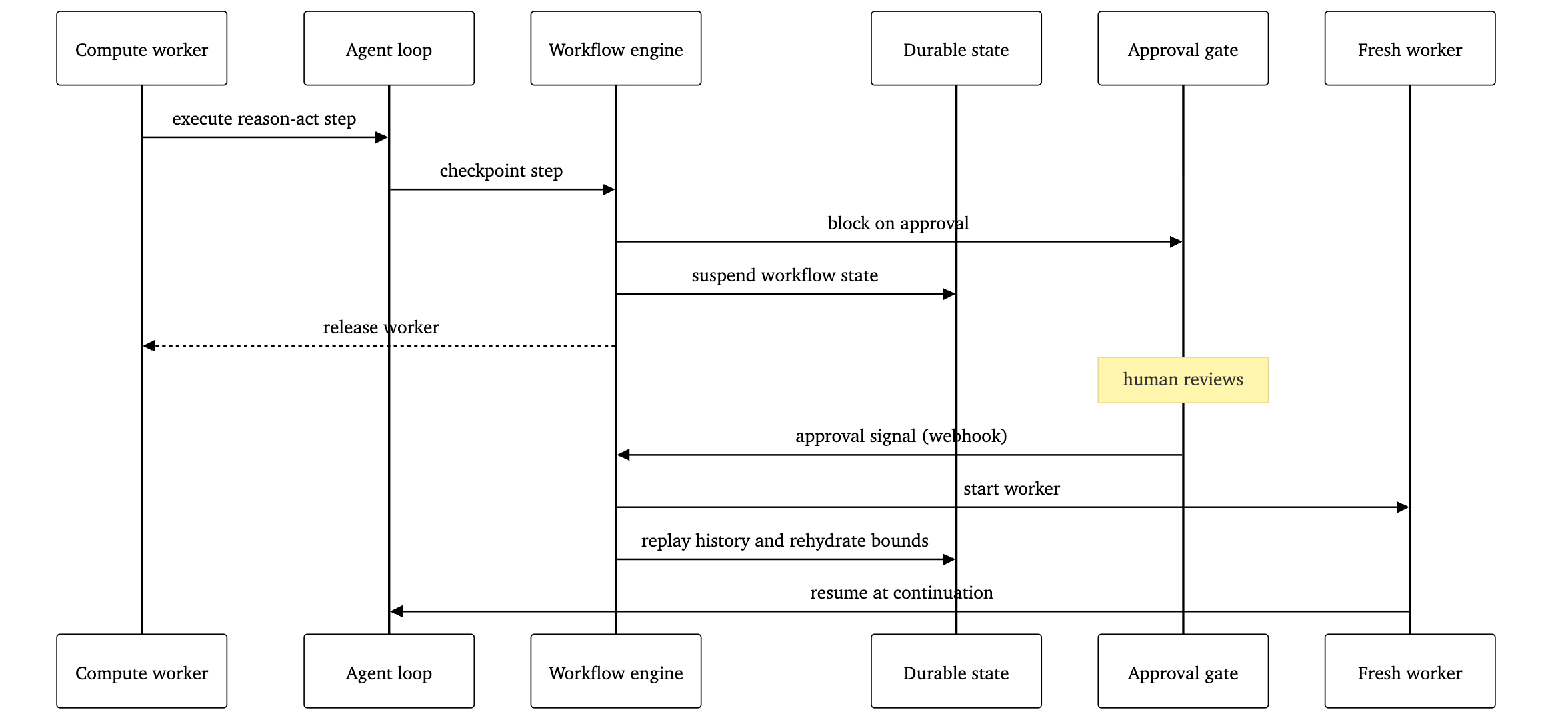
This is infrastructure, not application code: workflow engines and cloud step-function services provide durable execution as a managed primitive, and the discipline is to express the agent loop as a durable workflow from the start. The durable history is what preserves the shell’s state (bounds, ledgers, pending approvals) across the loss of any worker; without it, long-running agents cannot survive the cloud infrastructure they are deployed on.
Cost economics
Cost is a first-class operational concern. Agentic systems can be expensive in ways non-agentic systems are not: long-running reasoning, multi-iteration loops, multi-agent fan-out, expensive tools. The discipline:
Cost dimensions to track
Every production agentic system should track these per session:
Per-session cost should be in the trace (Chapter 12); aggregate cost should be in the operational dashboard.
Cost attribution and chargeback
In enterprise deployments the central platform team often absorbs the entire model bill because it cannot attribute spend. The operational fix is to inject attribution metadata, tenant-id, agent-id, business-unit, session-id, into every outbound request to the provider, and into the trace. This lets finance perform chargeback, so a runaway agent drains its own department’s budget rather than the company’s, and it makes the cost percentiles below sliceable by the dimension that matters once an investigation starts.
Cost as a distribution
Aggregate averages mask the long tail. A system with a mean cost of $0.10 per session and a 99.9th percentile of $25 has an order-of-magnitude problem. Operate on percentiles:
Alert on shifts in the percentiles, not only on totals.
Prompt caching as architectural lever
Provider-side prompt caching reduces the cost of repeated system prompts and tool documentation. The architectural commitments are: structure prompts so the static prefix is large and the dynamic content is at the end; reuse session structures so cache hits are common; monitor cache hit rate as an operational metric. Anthropic and other providers expose caching mechanisms; the architecture should be designed to exploit them.
Context window as cost lever
The context the agent receives determines a substantial fraction of cost. The architectural moves:
-
Tool documentation on demand through the Skills layer (Chapter 10), loaded when the task needs it.
-
Retrieval-mediated context that selects relevant material for each turn (Memory architecture, Chapter 7).
-
Summarization at episode boundaries that preserves useful state without carrying verbatim history (Chapter 7).
-
Progressive disclosure that loads procedural detail when needed (Chapter 10).
The team that operates these levers carefully pays an order of magnitude less per session than the team that does not.
Cost as governance signal
Sustained increases in cost without explanation are a signal. Possible causes: model drift; memory accumulation causing larger contexts; new tools being used; new skills being loaded; users asking different questions. Investigate; do not paper over with budget increases.
The ceiling on any session’s budget is the value of the task it performs. A session that reliably costs more than the work it replaces has failed economically even when every run succeeds technically, and the attribution identifiers above are what make that comparison possible per use case rather than per invoice.
Scaling
Agentic systems scale differently from stateless services. The constraints:
Per-session resource cost
Each session has a non-trivial resource footprint: the model call, the trace storage, the memory writes, the tool invocations. Scaling horizontally is straightforward; scaling each session efficiently is the harder problem.
Concurrency and rate limits
Model providers impose rate limits. Tools impose their own. The architecture has to manage:
-
Backoff and queuing. Provider rate-limit responses should trigger backoff, not immediate retry.
-
Circuit breakers. Providers experience brownouts, latency spikes, and 5xx storms. When a provider degrades, trip a circuit breaker and fail fast, or route to the fallback model, instead of retrying indefinitely. Uncapped retries against a degraded provider exhaust the application’s own connection pools and memory, turning a provider brownout into a self-inflicted outage.
-
Concurrency caps. Each agent’s outbound concurrency to tools and models is bounded to avoid spiking.
The deterministic substrate must provide these operational properties.
Long-running sessions
Sessions that span minutes to hours are where the durable execution substrate described earlier in this chapter pays off operationally, and the payoff is economic: you cannot afford to hold a compute container open for three hours while the agent waits at a human approval gate. Because the agent is suspended to durable storage during the wait and rehydrated onto fresh compute when work resumes, a multi-hour gate costs storage, not a pinned container, and the per-session resource cost tracks active execution rather than elapsed wall-clock.
The wait itself, though, has a scaling limit the compute model does not solve: reviewer throughput. If sessions route to human approval faster than reviewers clear the queue, the queue, not compute, becomes the bottleneck, and tasks stall however cheaply they suspend. Treat approval-queue depth and time-to-decision as first-class operational metrics, size the reviewer pool against the rate of approval-bound sessions, and route by risk so the queue holds only the actions that genuinely need a human (Chapter 6).
Fleet operations
For systems running many agents (operations controllers, fleets of customer-support agents, distributed research swarms), the operational concerns scale with fleet size:
-
Fleet-wide observability. Cross-agent dashboards, drift detection across the fleet, anomaly detection per agent against fleet baseline.
-
Per-agent bounds enforced centrally. The bounding layer (Chapter 5) is shared infrastructure; per-agent bounds are configuration.
-
Cross-fleet governance. A policy update applies to all agents at once.
Centralized governance (Chapter 6) and centralized bounding (Chapter 5) are also the right operational pattern for fleets.
Observability
Observability in agentic systems extends standard practice with three additions:
Trace-as-primary
The structured trace (Chapter 12) is the primary observability artifact. Logs, metrics, and traces serve different but connected purposes:
-
Metrics for aggregate behavior (cost percentiles, latency percentiles, bound trigger rates, governance deny rates).
-
Logs for substrate concerns (errors, infrastructure events).
Governance events as observability signal
Every governance event, every validator pass or fail, every policy gate decision, every approval request and resolution, is an observable signal. Rates and patterns in these signals are operational data. Sudden increases in deny rate, approval-request rate, or validator-failure rate are early indicators of incidents.
Behavioral drift
Behavior drifts even when code and policy do not. The model is upgraded; the data distribution shifts; users ask different questions; tools change behavior. The observability discipline tracks:
-
Reasoning trajectory and thrash-rate metrics (Chapter 12).
Drift in any of these is a signal. The team’s job is to attribute the drift before it becomes an incident.
Operating the governance layer
The disciplines above treat the agent and the model as the things being operated. The governance layer is itself a system that has to be operated, and the chapter’s earlier pointers (per-agent bounds as configuration, policy updates that apply fleet-wide, governance deny rate as a drift signal) introduce that layer without developing it fully. Three concerns surface only in production.
Config rollout for the governance layer
Tightening a bound or adding a policy gate across a fleet is itself a risky change. A bound tightened too far blocks legitimate work; a policy gate added without a schema or test can produce false positives that erode user trust. Treat governance changes with the staged canary-and-rollback discipline used for model upgrades. Blocking legitimate work is a production incident, however the change was packaged.
Ship a tighter bound or new policy to a canary cohort first. Measure its deny rate and false-positive rate against the baseline cohort, then promote it only when the intended effect appears without collateral blocking. Keep a one-command rollback ready so a policy producing false positives at scale can be reverted within minutes. Policy-as-code provides the substrate, as pinned versions do for model rollback. Rehearse the rollback to verify that it meets the recovery objective and that permissions, dependencies, and state transitions still permit it.
Governance-layer observability
The observability section above treats governance events as a signal about the agent: a sudden deny-rate spike means the agent is behaving differently. The same spike can also mean trouble in the governance layer itself, and calibrating that layer is developed in Chapter 12. When the deny rate spikes, the on-call engineer faces a four-way attribution problem: is it an attack (genuine malicious traffic), a policy bug (the gate is mis-firing on legitimate traffic), a distribution shift (the agent is now proposing different actions because the input changed), or model drift (the agent’s proposals changed because the model changed)?
Two metrics disambiguate. The deny rate measures how often the layer refuses. The false-positive rate measures how often it is wrong: the rate at which the layer refuses actions a human reviewer would have allowed. The false-positive rate is the metric that erodes user trust: a denied legitimate action produces no incident, only a frustrated user, and it is never named in the standard dashboard. Track both, and treat the false-positive rate as first-class.
The diagnostic loop, on a spike, is to sample the denied actions, have a human annotate each as correctly or incorrectly denied, and read the ratio. A high false-positive rate with a stable input distribution points to a policy bug. A high false-positive rate with a shifted input distribution points to distribution shift. A low false-positive rate with a high deny rate points to an attack, or to model drift producing genuinely risky proposals. The loop closes when the attribution is made, because each cause has a different response (a policy fix, a canary rollback, a model rollback, or an incident response), and only the attribution tells the engineer which.
Coordinated cross-artifact change
Adding a tool is a single logical change that spans the action surface (Chapter 5), the tool’s schema (Chapter 6), the policy gates that govern it (Chapter 6), the risk scorer’s contribution for the new action class (Chapter 6), the tests that assert the schema and the policy (Chapter 12), and any skills that declare the tool in their requires_tools (Chapter 10). Each artifact is version-controlled individually, but nothing ties the change together by default. That is how a tool ships with a schema but no policy, a policy but no test, or a skill that declares a tool the action surface does not yet admit.
A single change record gates all of these artifacts. Tool admission is one reviewable unit covering the action surface, schema, policy, scorer, tests, and dependent skills. The change is not mergeable until every slot is filled. This is the cross-artifact equivalent of the coordinated change that microservices teams already do for a database migration that spans schema, code, and rollback: the artifacts are individually versioned but the change is one logical unit, and the process has to enforce that.
Security
Security is an operational concern with agentic-system-specific shape. The threats:
-
Prompt injection at every input boundary (user input, retrieval content, tool responses, skills, inter-agent messages).
-
Lethal trifecta (Chapter 6), untrusted content + sensitive data access + external action capability, defended by governance layered defenses.
-
Tool-side compromise, tools that the agent invokes can themselves be compromised; the architecture must not trust tool responses unconditionally.
-
Supply chain, skills from untrusted sources are a supply chain risk; admission must verify provenance.
-
Data exfiltration, the agent’s ability to compose outputs creates an exfiltration channel if memory scoping is not enforced.
The architectural commitments from earlier chapters address these threats, but operationally:
-
Threat modeling is done at design time, repeated on architectural changes, and exercised via adversarial testing (Chapter 12).
-
Incident response runbooks include agent-specific scenarios: rapid trace inspection, identifying compromised tools, rolling back skill admissions, model version rollback.
-
Access reviews are routine: who has authority to admit skills, change policies, modify bounds, approve high-stakes actions?
-
Network egress filtering is the deterministic backstop against exfiltration. The ultimate bound is not in the prompt or the model: if an agent is tricked into running a script that
curls an attacker’s server, a zero-trust egress policy at the VPC, container, or Kubernetes layer blocks the outbound connection. Connect agent security to standard DevOps network security; an allow-list of egress destinations is one of the highest-impact controls available.
Lifecycle
Agentic systems have lifecycles. The disciplines:
Onboarding new agents
The deployment of a new agent or new agent class requires:
-
Architectural review (does it fit the bounded-and-governed pattern?).
-
Bound specification (the six axes of Chapter 5).
This is a checklist, not a process to skip. Most production incidents come from agents deployed without one of the items above.
Retiring agents
Agents are retired the same way: declared deprecated; traffic drained; bounds tightened during the retirement window; trace retention extended for incident response; finally removed.
Skill lifecycle
Skills are versioned. Admission accepts pinned versions. Updates go through a review process. Deprecations are announced. Retired skills cannot be loaded.
Memory lifecycle
Memory has retention. Working memory is task-scoped (gone at task end). Episodic memory has a TTL or right-to-be-forgotten triggers (Chapter 7). Semantic memory is curated; superseded entries are retired. The lifecycle is part of the system, not an afterthought.
Policy lifecycle
Policies evolve. New regulations, new product features, new threats. Policy changes are version-controlled. Policy reviews happen on a regular cadence. Policy coverage is tested. For deployments in regulated jurisdictions, the policy lifecycle must track evolving oversight obligations. As of mid-2026, the EU AI Act’s Article 14 human-oversight requirements for high-risk systems are the reference case (Chapter 6), with conformity obligations staged on a rolling calendar.
Retrofitting an ungoverned agent
The architecture in this book is easiest to apply to a system being built fresh. The more common situation is the opposite: an agent is already in production, built quickly by a team under pressure, with none of these commitments, and it cannot simply be switched off, because something now depends on it. Brownfield SaaS integration (Chapter 14) covered adding a new agent to an existing platform through the backend-for-agent pattern; this is the inverse problem, wrangling an existing ungoverned agent into the architecture without a rewrite.
The retrofit proceeds in three stages, in order, each shippable on its own and each a prerequisite for the next.
-
Trace first. Before changing what the agent does, change what is known about it. Wrap the loop so that every model call, tool call, and outcome emits a structured trace (Chapter 12). This alters no behavior, but it ends the blindness, and it surfaces the worst of what the agent is doing (runaway loops, cross-tenant reads, silent retries) for triage.
-
Insert the bounding layer. With traces showing the real distributions of cost, iteration, and action, interpose the bounding layer (Chapter 5) in front of the agent’s tool calls and set ceilings at the observed limits plus headroom. This is a pure interception; the agent’s own logic is untouched. The runaway cases the trace surfaced now abort instead of reaching the bill.
-
Implement the governance pipeline. Finally, route the agent’s consequential actions through schema validation, policy gates, and approval (Chapter 6), beginning with the single highest-risk action and broadening as confidence grows.
The order is not arbitrary: each stage rests on the one before, bounds are set from what the trace revealed, and governance is applied to actions already visible and bounded. Each stage also ships independently and removes a specific class of risk: the trace ends blindness, the bounds end runaway spend, and the governance pipeline ends ungated consequential actions. The team therefore hardens a live system incrementally rather than staking everything on a rewrite that may never come.
Building the operating discipline
The operating disciplines above are not a single team’s job. The architectural commitments determine what the discipline operates on; the team determines how the discipline is exercised. The recommended posture:
-
An on-call rotation that includes agent behavior as a category. Engineers who can read traces and understand the architecture.
-
A weekly review of operational signals. Cost percentiles, drift indicators, governance event rates, incident postmortems: read and discussed, not glanced at on a dashboard.
-
Periodic adversarial exercises. Quarterly at minimum. Real attempts to evade the bounding layer, inject prompts, exfiltrate data, abuse approval mechanisms.
-
Documented runbooks. What to do when costs spike; when an agent loops; when an incident is suspected; when a model version produces incidents on rollout.
-
Continuous evaluation in production (Chapter 12), running as a standing property of the system rather than as a one-off project.
These disciplines turn the architecture from a design into a running system.
Summary
Operational discipline turns the architecture into a working system. The disciplines are: deployment that treats the model as a pinned artifact and admits skills as version-controlled dependencies; cost economics tracked on percentiles with deliberate use of caching and context architecture; scaling that respects per-session resource cost and uses centralized governance and bounding; observability built on structured traces with governance events as signal; security defended through layered architectural commitments and routine adversarial exercise; lifecycle for agents, skills, memory, and policy.
One chapter remains. Everything developed so far surrounds a single component this book introduced in Chapter 4 while treating its design as a given: the loop that drives the model. That is the foundations of Part I, the architectural layers of Part II, the production disciplines of Part III, and the synthesis of Part IV to this point. Chapter 19 closes the argument by designing that loop directly, the harness, the deterministic envelope in which every prior commitment is enforced, and answers the practitioner’s recurring question of where a new capability belongs: in code, in a tool, in a skill, or in a new agent. After it, Chapters 20 and 21 are reference, a glossary of terms and an annotated bibliography pointing to the canonical sources the book defers to, and the Epilogue closes the book.